Cyber threats are becoming more advanced, with attackers combining technical exploits and human manipulation to gain access to systems and data.
At the same time, regulatory expectations are increasing. Organizations are required to implement policies, controls, and processes that demonstrate how risk is actively managed across the business. Frameworks such as GDPR, NIS2, and ISO 27001 make it clear that compliance is not limited to technology. It also depends on how people and processes operate in practice.
Meeting these standards requires investment. But the cost of falling short is often higher, including regulatory penalties, operational disruption, and loss of trust. The good news: with the right approach, compliance becomes a natural byproduct of a stronger security culture, not a separate burden.
Compliance and regulations
Organizations today must comply with a growing number of cybersecurity regulations and standards, each with specific requirements for managing risk, protecting data, and demonstrating accountability.
PCI DSS: Defines security requirements for organizations handling payment card data
While these frameworks differ in scope, they share common expectations:
risk must be actively managed
controls must be implemented and maintained
activities must be documented and measurable
Common challenges in achieving compliance
Meeting regulatory requirements is rarely straightforward.
Organizations often face challenges such as:
interpreting complex and evolving regulations
aligning policies with real-world operations
maintaining consistency across teams and regions
demonstrating compliance during audits
Compliance is not a one-time effort. It requires continuous alignment between policies, processes, and day-to-day activities.
The role of human risk in compliance
Many compliance requirements extend beyond technical controls. They depend on how employees handle information, respond to incidents, and follow internal processes.
This is where organizations often fall short.
Phishing, social engineering, and simple mistakes can undermine even well-designed security controls. As a result, managing human risk has become a central part of modern compliance. This is what we call the human defense layer; the combination of confidence, clarity, and trust that turns people from a liability into your strongest control.
What compliance requires from your organization from day one
Compliance starts with understanding what applies to your organization and ensuring your approach is aligned from the beginning.
Regulations such as NIS2 make it clear that efforts must be:
continuous
role-based
risk-aware
This means organizations need to:
structure activities based on roles and responsibilities
align processes with internal policies and risk assessments
ensure consistency across teams
A structured, tailored approach from the start makes it significantly easier to meet requirements and demonstrate compliance over time.
How to Keep Compliance Activities Continuous and Risk-Aware
Cyber compliance is not a one-time effort. Regulatory frameworks such as NIS2 require organizations to demonstrate that activities are ongoing, relevant, and aligned with evolving risks.
This means moving beyond static, one-off initiatives toward a more continuous and adaptive approach.
In practice, organizations need to:
maintain regular, structured activities over time
align efforts with current threats and risk exposure
ensure relevance across roles and responsibilities
A continuous approach allows organizations to:
keep pace with changing threat landscapes
reinforce expected behaviors and processes
demonstrate consistency during audits and reviews
Nimblr supports this by automating ongoing compliance activities such as training, simulations, and reporting, integrating them into daily operations without increasing administrative burden.
How to Prove Your Policies Are Actually Working
Cyber compliance is not just about completion. It requires organizations to demonstrate that policies and controls are effective in practice.
This means showing that employees can recognize risks, respond appropriately, and improve over time.
reinforcing correct behavior through targeted follow-up
This type of real-time reinforcement helps:
strengthen secure habits
reduce repeated risk
provide measurable evidence of improvement
Nimblr supports this by providing immediate feedback and targeted follow-up actions based on user behavior, making it easier to demonstrate measurable improvement in compliance efforts.
READY WHEN YOU ARE
Turn human risk into real defense
Book a demo and see how continuous training and realistic simulations change behavior where it matters.
Partnerships
Proven in practice
Organizations across Europe are already using Nimblr to meet NIS2 and other compliance requirements:
Fujitsu partners with Nimblr to launch a Managed Human Risk Reduction service, helping organizations reduce human cyber risk and comply with NIS2.
How to Get Audit-Ready Visibility and Documentation
Regulatory frameworks such as NIS2 require organizations to demonstrate that risk is actively managed and that compliance efforts are both consistent and measurable.
This makes visibility and documentation essential.
ensure that required actions are completed on time
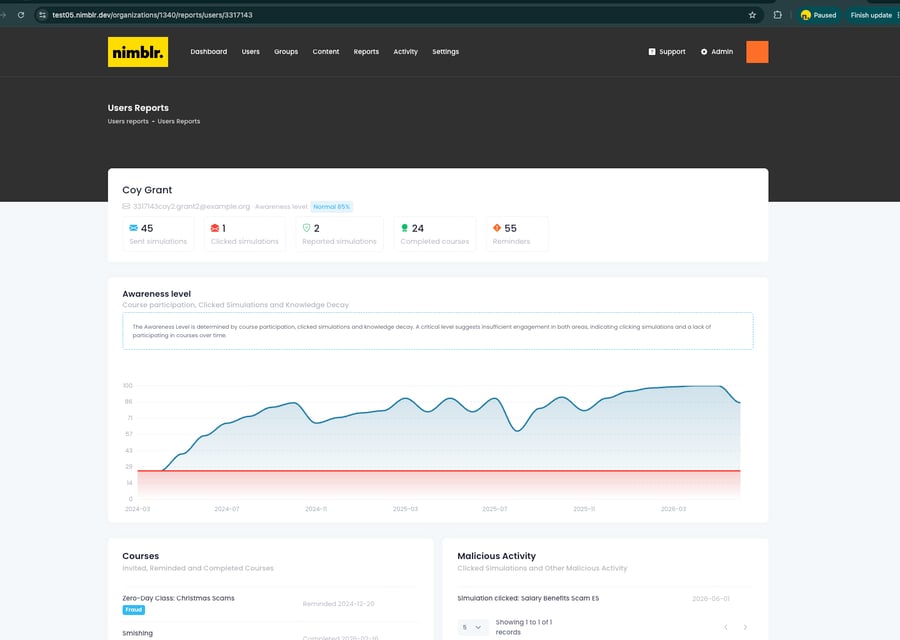
Nimblr supports this by providing structured reporting and automated tracking of training activities and user behavior, making it easier to generate audit-ready documentation such as completion records, engagement data, and simulation results.
How to Stay Compliant as Regulations and Threats Evolve
Regulatory requirements and threat landscapes are constantly evolving. What meets compliance standards today may not be sufficient tomorrow.
Organizations need to ensure that their processes and activities remain relevant without relying on manual updates or periodic reviews.
Nimblr supports this by continuously updating training content and aligning activities with current threats and regulatory changes, helping organizations maintain compliance over time without increasing internal workload.
The Outcome: A workforce that supports your compliance goals
By following a structured approach to compliance, your organization moves beyond meeting minimum requirements and builds a more resilient, accountable operation.
This results in a workforce that:
understands and follows required processes and policies
responds appropriately to real-world risks and incidents
contributes to measurable, auditable compliance efforts
helps reduce overall organizational risk
Compliance then becomes more than a regulatory obligation. It becomes a foundation for stronger security and operational resilience.
Don't just meet requirements. Turn compliance into an advantage.
Book a demo to see how Nimblr can support your journey toward effective, sustainable cyber compliance.
Frequently asked questions
Does Nimblr help with NIS2 compliance specifically?
Yes. NIS2 requires continuous, role-based, risk-aware security awareness activities, and Nimblr automates training, simulations, and reporting to meet that standard. See our NIS2 training requirements guide for details.
Is Nimblr enough to be fully compliant on its own?
Compliance frameworks like GDPR, NIS2, DORA, ISO 27001, and PCI DSS cover both technical controls and how people and processes operate. Nimblr addresses the human-risk side, continuous training, behavior reinforcement, and audit-ready reporting, but full compliance also depends on the technical and organizational controls covered elsewhere in these frameworks.
How does Nimblr provide audit-ready documentation?
Nimblr tracks activities across teams and users and generates structured reporting, including completion records, engagement data, and simulation results, so documentation is ready when you need it for an audit.
How often is training content updated to reflect new regulations or threats?
Nimblr continuously updates training content and aligns activities with current threats and regulatory changes, so your program stays relevant without manual updates or periodic reviews.
Features
Role-based learning
Security training matched to real job risk. Nimblr role-based learning matches training depth to the risk each role carries.
Micro training
Interactive lessons under five minutes, in 30+ languages, delivered when they are most relevant.
Instant learning
Click a simulated attack and Nimblr delivers immediate feedback and a short lesson, turning mistakes into learning, not punishment.
Simulations
Realistic, customer-specific phishing, smishing, fraud and malware simulations, built from real attack data and delivered at randomized times.
Custom content
Turn your IT Policy, Code of Conduct, or company rules into a native Nimblr course. AI builds the draft, you edit with prompts, publish in any language.
Reporting
Track security awareness with Nimblr's Awareness Level, automated monthly reports, and a full event log. Clear insights for admins, auditors, and boards.
Integrations
Connect Nimblr to Microsoft Entra ID, Google Directory, or SFTP for automated user sync, and activate the Microsoft report button. Setup guides included.
Set up
Set up your organization and screen users to get your Nimblr security awareness program running quickly.






.png?width=320&height=323&name=nimblr-puzzle-pieces-connection-solution-game%20(1).png)