Step 1
Platform
Security awareness training that changes employee behavior
Training that meets people where they are
Reduce human risk with security awareness training
Nimblr is a security awareness training platform that helps organizations reduce human risk by improving how employees recognize and respond to cyber threats.
Your users aren't the weakest link, but they can be an easy target.
Attackers don't break in: they log in, exploiting human behavior rather than technology gaps.
The difference between risk and resilience? Training.
How does it work
Step 2
Automated delivery, managed by experts
A practical approach to security awareness
Nimblr is a fully managed security awareness platform focused on improving security behavior, not just delivering security information.
Built on behavioral science and real‑world threat data, Nimblr brings together short, practical training, phishing simulations, continuous testing, awareness-level scoring, and reporting in one integrated system.
Because knowing what to do isn't enough. Employees also need to recognize risk, make decisions under pressure, and respond correctly when something feels wrong.
Security awareness training built for real behavior
Security awareness isn't just about learning; it's about applying knowledge in moments of uncertainty, time pressure, and incomplete information.
Security awareness is most effective when it reflects how people actually think and work.
Employees don't make decisions in controlled environments. They make them quickly, often while multitasking, under time pressure, or when something looks almost legitimate. A phishing email rarely looks obviously malicious. A request from a colleague may seem routine. A link may look familiar enough to trust.
That's why security awareness training must go beyond explanations and policies. It should help employees recognize patterns, challenge assumptions, and respond correctly when something feels slightly off.
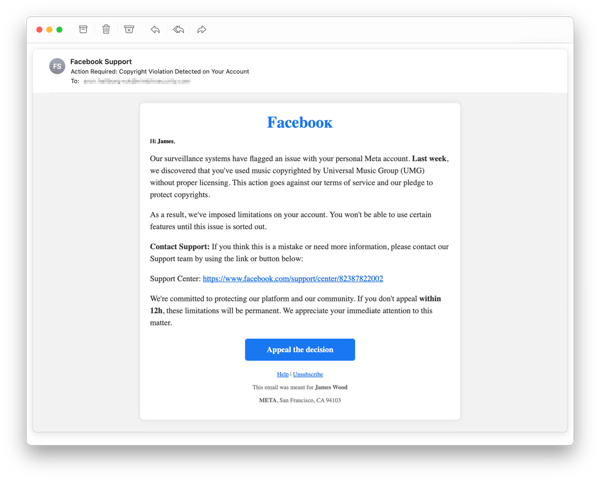
Nimblr supports this through continuous learning and testing. Instead of relying on a single annual course, employees develop awareness over time through short lessons, repeated exposure, realistic scenarios, and immediate feedback.
Over time, this builds habits. Employees become more comfortable identifying risks, more confident in their decisions, and more likely to take the right action when it matters most.

A practical approach to security awareness
Nimblr is a fully managed security awareness platform focused on improving security behavior, not just delivering security information.
Built on behavioral science and real‑world threat data, Nimblr brings together short, practical training, phishing simulations, continuous testing, awareness-level scoring, and reporting in one integrated system.
Because knowing what to do isn't enough. Employees also need to recognize risk, make decisions under pressure, and respond correctly when something feels wrong.
Security awareness isn't just about learning; it's about applying knowledge in moments of uncertainty, time pressure, and incomplete information.
How the platform works
Short security awareness training
Employees receive short security awareness courses that take less than five minutes to complete.
The training is designed to fit naturally into the workday. Instead of long, disruptive sessions, learning is delivered in small steps over time; making it easier to stay engaged and retain key concepts.
The content focuses on practical, real‑world situations employees encounter every day, including phishing emails, social engineering, fraud attempts, password security, and the safe handling of sensitive information.
Courses are interactive and go beyond explaining threats. They show how risks appear in real life and guide employees on what actions to take in each situation.
All content is available in more than 30 languages, enabling consistent security awareness training across global teams while keeping the experience relevant for every user.
Phishing simulations that test real behavior
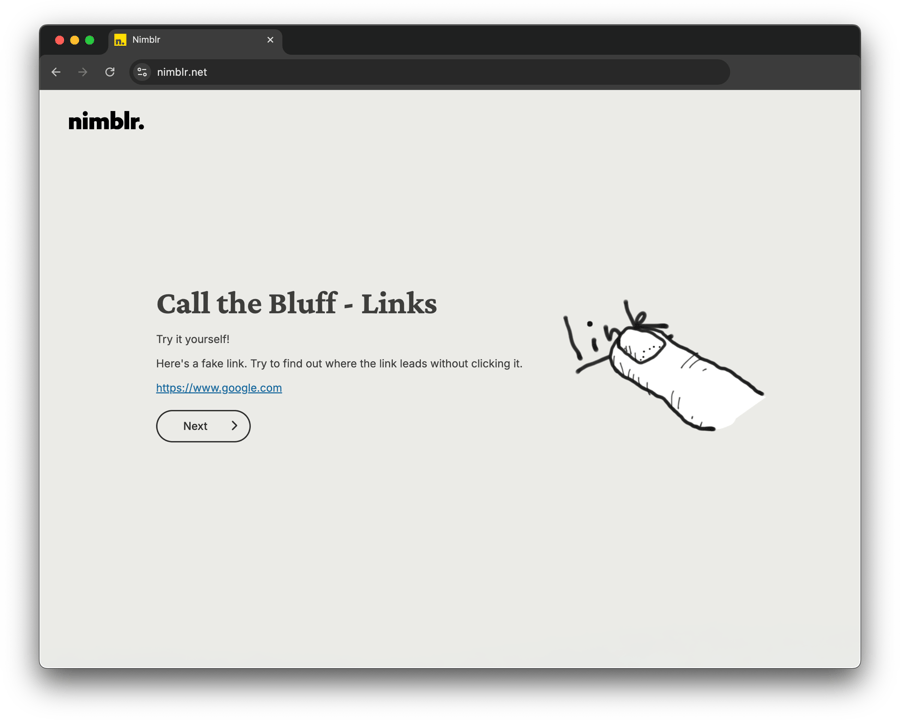
Training alone doesn't change behavior. Employees also need to be tested in realistic situations where decisions feel real.
Nimblr continuously delivers phishing simulations and social engineering scenarios that reflect current attack techniques. These simulations are designed to closely resemble the emails and messages employees encounter in their daily work.
Instead of only learning what phishing looks like, employees experience it in a safe environment. This helps them apply what they've learned, reinforce correct responses, and build practical decision‑making skills.
Simulations adapt over time based on employee behavior, role, and previous interactions. This keeps testing relevant and challenging, avoiding the limitations of one‑size‑fits‑all phishing campaigns.
Immediate feedback after mistakes
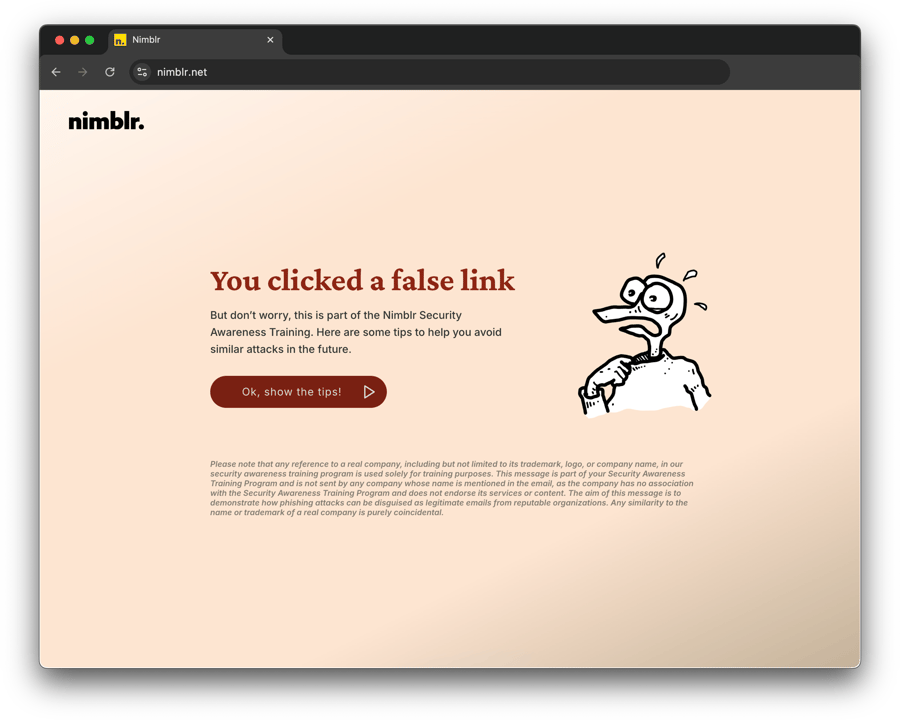
When an employee interacts with a phishing simulation or misses a warning sign, they receive immediate feedback.
The feedback highlights which indicators were overlooked and explains why the situation posed a risk. This is followed by a short, targeted lesson that reinforces the correct response.
Timing is critical. Learning happens at the moment of action, while the situation is still fresh in the employee's mind—making it more relevant and easier to remember.
This approach accelerates learning and helps employees build a deeper, more practical understanding of how threats actually appear in real‑world situations.
Risk assessment for every employee
Nimblr continuously assesses human risk across the organization.
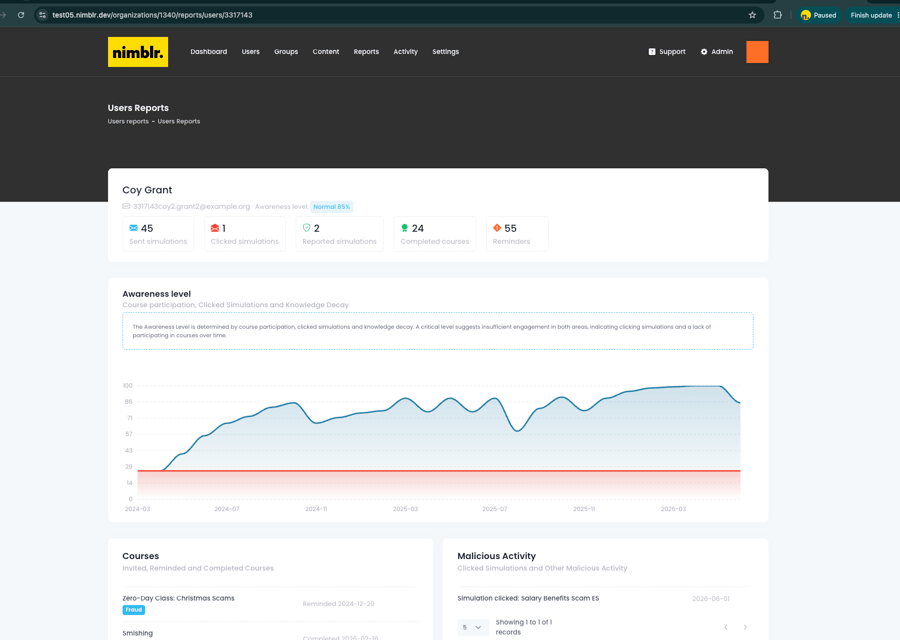
Each employee's awareness level is based on real behavior—how they engage with training, how they respond to simulations, and how their actions change over time.
This provides a more accurate view than assumptions or static assessments. It makes it easier to see where risk is concentrated, identify employees who need additional support, and track which behaviors are improving as awareness grows.
Group-level overview for leaders and admins
Leadership and administrators receive a clear overview of security awareness at group level.
Instead of relying on general completion rates, you can understand how different teams are performing in practice.
Nimblr screenshot awareness level over time
For example:
-
Which departments are improving over time
-
Which teams are more exposed to phishing risk
-
Whether certain roles require additional focus
-
How behavior changes after training and simulations
This allows organizations to take targeted action instead of applying the same approach to everyone.
Admin portal and reporting
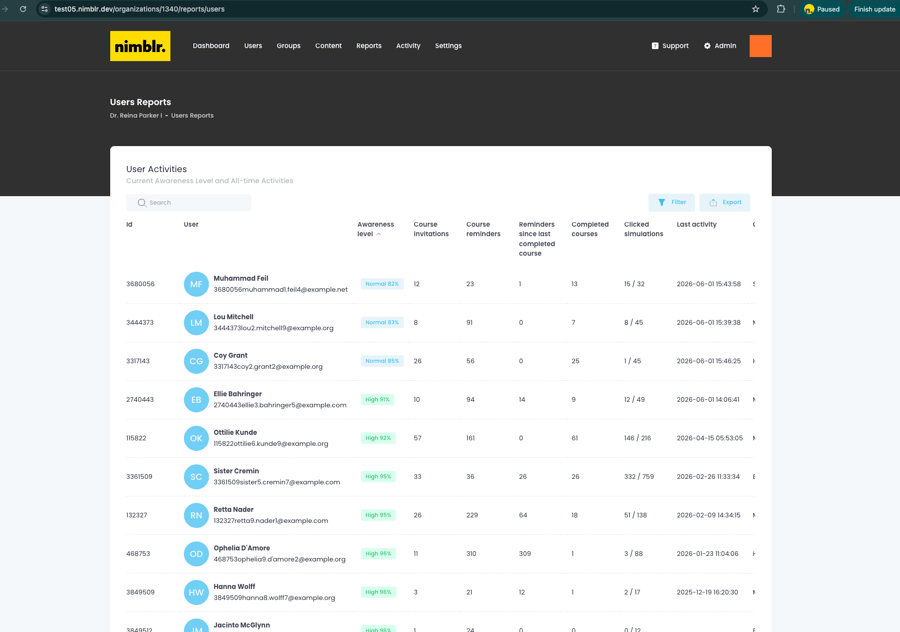
The platform includes an admin portal with clear and accessible reporting.
Admins can follow training completion, simulation outcomes, behavioral trends, and overall risk levels. The interface is designed to make it easy to understand what is happening and where attention is needed.
Reporting can be used for internal follow-up, management reporting, customer requirements, cyber insurance documentation, and compliance purposes.
The goal is to make security awareness easier to manage without losing visibility or control.
Automated delivery with expert-led management
After a short setup, Nimblr runs automatically with very little need for ongoing administration.
Training is delivered continuously. Simulations are scheduled and adapted. Content is updated.
At the same time, Nimblr's experts ensure that each employee receives relevant courses and simulations based on their behavior, role, and risk level.
This means organizations do not need to plan campaigns, assign training manually, or monitor every detail. The platform and the team behind it manage the process continuously.
This reduces workload while maintaining a consistent and effective security awareness program.
Always updated to reflect current threats
Cyber threats evolve continuously, and training needs to reflect that.
Nimblr updates training content and phishing simulations based on real-world attacks and emerging threat patterns. This ensures that employees are exposed to relevant and current scenarios.
Employees learn to recognize modern phishing emails, new types of scams, and evolving social engineering techniques — not outdated examples that no longer reflect reality.
90% of successful cyber-attacks start with a phishing email.
(CISA.gov)
Why this approach works
Security awareness is not only about knowledge. It is about judgment, timing, and habit.
Many security incidents happen when an employee is unsure what to do. The message may look almost correct. The request may feel urgent. The sender may appear familiar. In that moment, the employee has to decide how to respond.
Training needs to prepare employees for that situation.
Nimblr helps employees:
-
Recognize when something is not quite right
-
Understand what signals to look for
-
Decide what action to take
- Know how and where to report suspicious activity
By combining training with continuous testing and feedback, employees develop practical skills and stronger decision-making over time.
See how Efta improved cybersecurity and streamlined awareness with Nimblr
Security awareness that supports real-world decisions
Technical security controls are essential. Email filtering, multi-factor authentication, endpoint protection, and detection tools all play a critical role.
However, these controls do not eliminate risk entirely. Some threats will still reach employees.
At that point, the outcome depends on human behavior.
Employees need to interpret the situation and decide what to do. A security awareness platform should support that decision-making process.
Nimblr is designed to help employees handle what technical controls cannot fully prevent.
Security awareness training for all company sizes
Organizations of all sizes are targeted.
Small and mid-sized companies are often seen as easier targets because attackers expect weaker defenses or less structured security awareness. Larger organizations face the same challenges across more users and more complex environments.
In both cases, human behavior remains a key factor.
That is why security awareness training needs to be continuous, relevant, and easy to maintain regardless of company size.
More than a compliance exercise
Security awareness training is often required for compliance, cyber insurance, customer expectations, or subcontractor agreements.
Nimblr helps organizations meet these requirements through structured training, documented activity, and clear reporting.
At the same time, the purpose is not only to meet requirements. The goal is to reduce real risk by improving how employees think and act in everyday situations.
Compliance may be necessary. Behavior change is what reduces risk.
Security awareness that extends beyond work
Cyber threats do not only target employees in their professional roles. Phishing, scams, and fraud also affect them in their personal lives.
When employees learn how to recognize suspicious messages and handle them safely, that knowledge often carries over outside of work.
This strengthens awareness in a broader sense and contributes to more consistent, long-term behavior change.
What employees gain
Employees receive training that is short, practical, and directly relevant to their daily work.
They learn how to identify common attack techniques, understand what makes a situation risky, and know what action to take.
Through simulations and feedback, they build confidence and develop habits that help them respond correctly in real situations.
What admins and leaders gain
Admins and leaders get a security awareness platform that requires minimal ongoing administration after setup.
They gain visibility into employee risk, simulation outcomes, training progress, and group-level performance.
This makes it easier to identify where additional support is needed, measure improvement over time, and maintain an effective security awareness program without extensive manual effort.
For technical setup and rollout guidance, admins can also reference the Nimblr Knowledge Base.
A security awareness platform designed to reduce human risk
Nimblr combines short courses, phishing simulations, continuous testing, and employee risk assessment into one platform.
The result is a practical and effective approach to security awareness training, one that helps employees recognize threats, make better decisions, and contribute to a stronger security culture over time.
Features
Role-based learning
Micro training
Instant learning
Simulations
Custom content
Reporting
Integrations