Five habits that make security part of how your team works
Cybersecurity doesn't fail because of bad tools. It fails because of habits. Here is how to integrate security awareness into daily routines so your employees stay protected without thinking of it as extra work.
In this article:
Why the threat landscape demands a cultural response
Five daily habits that build lasting security awareness
How to get leadership and new hires on board
How Nimblr makes the habits stick automatically
The threat landscape has changed. Your response needs to as well.
Cybercriminals no longer focus exclusively on large enterprises with deep pockets. Small and mid-sized organizations across Europe are now primary targets because they hold valuable data and typically have less mature defenses.
The most common threats your employees will encounter are familiar, human-targeted attacks that rely on someone being distracted, trusting, or simply unaware:
Phishing: deceptive emails designed to steal credentials or install malware via a click
Smishing: the same tactics via SMS, increasingly common as work moves to mobile
Social engineering: manipulating employees into bypassing security procedures through trust and authority
Ransomware: malware that locks systems until a ransom is paid, often delivered via a phishing link
The scale is well documented: the Verizon 2025 Data Breach Investigations Report found the human element involved in 60% of breaches, with ransomware present in 44%. As an IT manager or security officer, you need more than the right tools. You need a well-informed workforce, because one employee's mistake can open the door to a serious breach.
EU legislation such as NIS2 makes this more than good practice: organizations in scope must implement security awareness training and demonstrate an active security culture, or face real compliance risk. Read more about NIS2's training requirements.
Make security awareness stick
Five habits that make security awareness stick
1. Run training that employees actually complete
Long annual compliance courses get clicked through, not absorbed. The most effective training is short, frequent, and arrives in context: a three-minute module on phishing the week after a phishing simulation, not a 45-minute all-hands session in January.
With Nimblr, employees don't need to log in or block out calendar time. The training comes to them, via email, on any device, and takes minutes, not hours. That is the difference between training that gets done and training that gets deferred indefinitely.
Practical tip: set a target of at least one short training touchpoint per month per employee, and pair it with simulated attacks so the content feels immediately relevant.
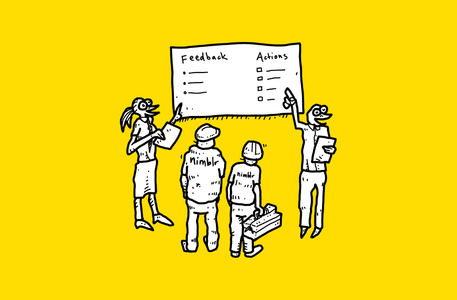
2. Make security a regular team conversation
Waiting for an incident to discuss security is like waiting for a fire to talk about fire safety. A monthly ten-minute check-in keeps awareness active and normalizes reporting suspicious activity, which is often the most important early warning signal.
You don't need an agenda. Simple, open questions prompt useful discussion:
Has anyone received a suspicious email or text recently?
What are the signs you would look for in a phishing attempt?
Who do you contact if something seems off, and is the process clear?
Any new tools or apps you have started using that IT should know about?
Nimblr's Awareness Level helps you identify which teams have the lowest awareness, so you know where those conversations matter most.
3. Get leadership to treat security as a business priority
Security culture flows downward. If executives treat awareness training as an IT checkbox, employees will too. When leadership actively participates, completing their own training, referencing security in all-hands meetings, funding proper programs, it signals that this matters.
The business case is straightforward: the IBM Cost of a Data Breach Report 2025 puts the global average cost of a breach at $4.44 million, and regulatory fines under GDPR and NIS2 can reach tens of millions of euros. A strong security culture is one of the most cost-effective risk mitigations available.
Practical tip: present leadership with the phishing simulation click rates from your own organization. Real numbers from inside the business are more persuasive than industry statistics from a report.
4. Keep your security policies current and visible
Attackers update their tactics constantly. A password policy written in 2021, or an acceptable use policy that doesn't mention AI tools, is already outdated. Policies that nobody reads or that haven't been revised in years don't protect anyone; they just create a false sense of coverage.
Schedule a quarterly review of your core security policies: password requirements, device guidelines, acceptable use, and incident reporting. Each review is also an opportunity to communicate changes to employees in plain language, not just update a document on an intranet nobody visits.
Practical tip: when you update a policy, send a one-paragraph plain-language summary to all employees. It takes five minutes to write and dramatically increases the chance they will actually absorb the change.
5. Build security awareness into onboarding from day one
New employees are among the highest-risk groups in any organization: they are unfamiliar with internal systems, eager to be helpful, and unlikely to question unusual requests. A strong onboarding program closes that window of vulnerability quickly.
Security onboarding doesn't need to be a full-day course. It needs to cover the essentials clearly and be followed up with regular training:
-
Your organization's core security policies and why they exist
-
How to recognize phishing emails and smishing texts
-
Password and device security requirements
-
Exactly how and where to report something suspicious
-
What to do if they think they have already made a mistake
How Nimblr makes this automatic
Building these habits manually, scheduling training, tracking completion, running simulations, following up with non-completers, is a significant administrative burden for most IT teams. Nimblr automates the entire cycle.
New employees are enrolled automatically and receive onboarding training without IT intervention. Phishing and smishing simulations run continuously and adapt to each user's behavior. Completion and awareness-level data is available in real time, so you always know where your gaps are, before an attacker finds them.
More than 5,000 IT decision-makers use Nimblr to turn security awareness from a project into a permanent part of how their organizations work.
See what your team's awareness level actually looks like. Book a demo and we'll show you how Nimblr maps the gaps in your organization.
FAQ
FAQ: Security awareness in everyday routines
How do you build a security-aware culture without overwhelming employees?
The key is frequency over volume. Short, monthly touchpoints are far more effective than occasional long sessions. Keep training bite-sized, make reporting easy, and normalize security conversations in team meetings so it becomes part of the rhythm rather than an interruption.
Who is responsible for security awareness in an organization?
Formally, it usually sits with the IT or security team. But effective security culture requires visible support from leadership and active participation from managers. IT can provide the tools and training; culture requires buy-in at every level.
How does EU legislation affect security awareness requirements?
NIS2 directly requires organizations in scope to implement security awareness training and cybersecurity training for management, and to be able to demonstrate it. Organizations that cannot evidence ongoing employee training are at risk during audits.
How often should phishing simulations be run?
Regularly throughout the year, rather than as a one-off or annual exercise. Using a mix of realistic scenarios and varying difficulty is key: some scenarios are designed to be easier to recognize, others more subtle and challenging, reflecting real-world threats. This builds judgment and confidence while avoiding fatigue and a culture of blame.